The Brain’s Tug-of-War: What Risk and Reward Teach Us About Action
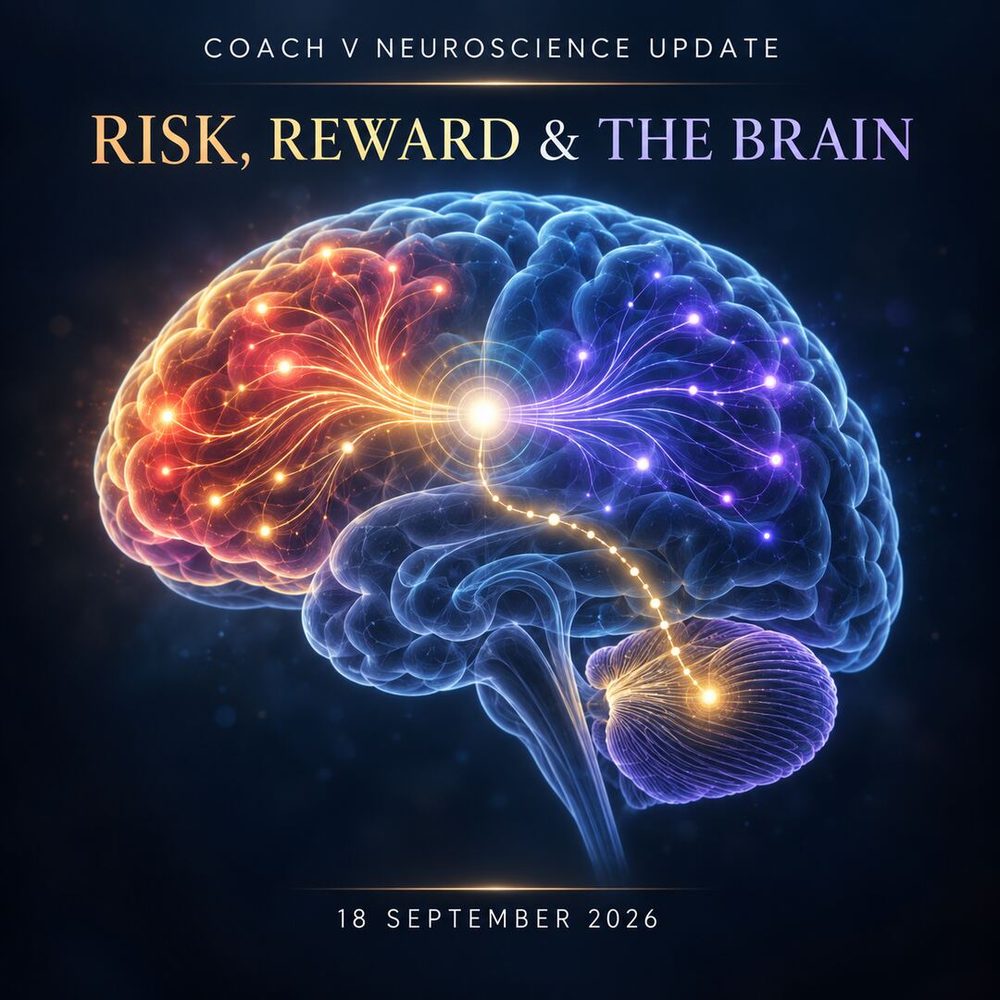
You know that moment when an opportunity looks exciting, but something in you still pulls back? A recruit sees the growth potential but fears leaving what is familiar. An Associate knows prospecting matters but avoids the phone. A seller wants the move but hesitates over the risk.
That tension is not automatically laziness or a lack of ambition. This week’s research gives us a more useful lens: approach and avoidance can compete in the brain right up to the moment of action.
1The brain can flicker between “go” and “hold back”
Published 15 September 2026 in Nature Neuroscience
Researchers recorded directly from the orbitofrontal cortex of six neurosurgical patients while they completed 192 to 220 rounds of a game involving different combinations of treasure and possible punishment.
Before participants chose to approach, activity increased in a medial orbitofrontal region while activity in a lateral region decreased. Importantly, the signals rapidly alternated between pro-approach and pro-avoidance states before the decision.
In plain language: a conflicted person may not have reached one stable conclusion and then acted. Their brain can keep moving between the potential gain and the possible cost until one state wins.
- Primary research nature.com
- Supporting open dataset and methods datadryad.org
COACHING APPLICATION: AN INFERENCE
When someone hesitates, repeating the benefit louder may miss half the decision. Ask two separate questions:
- What makes this worth moving towards?
- What specifically feels risky, costly or unsafe?
For a recruit, the reward may be growth and better support; the risk may be losing familiarity, income certainty or identity. Good coaching makes both sides speakable, then helps the person choose with clarity. It does not manipulate them into a yes.
2Reward learning reaches beyond the brain’s “usual” motivation circuit
Published 16 September 2026 in Nature Neuroscience
A mouse study challenged the old idea that the cerebellum mainly manages movement. Researchers trained mice to push a lever and wait for a delayed reward produced through direct stimulation of dopamine-related pathways.
Cerebellar granule-cell activity increased during the waiting period and scaled with the timing of the expected reward. Temporarily suppressing this delay-period activity impaired learning. Climbing-fibre signals responded when the reward arrived, and activating those fibres could support a more modest form of reward-seeking learning.
In plain language: the brain appears to build a timed bridge between an action, the expectation of what follows and the feedback that teaches whether the action is worth repeating.
- Primary research nature.com
LEADERSHIP APPLICATION: AN INFERENCE
A commission paid weeks later is important, but it is too delayed to be the only feedback that shapes daily behaviour. Make progress visible earlier:
Quality contacts → conversations → appointments → mandates → transactions.
Recognise the controllable behaviour, show what it produced and help the Associate adjust. That creates a clearer action-feedback loop than waiting for the final sale before anyone knows whether the process is working.
EVIDENCE CHECK
More established:
- People weigh potential rewards against potential costs when deciding whether to act.
- Dopamine-linked reinforcement and predictable feedback contribute to learning and motivated behaviour.
- The cerebellum contributes to cognitive functions beyond basic movement.
New and still preliminary:
- The human study offers rare direct recordings, but only six patients took part, all undergoing clinical monitoring. It maps activity associated with decisions; it does not prove that either orbitofrontal region caused the choice.
- The reward study used head-fixed mice and artificial brain stimulation. It provides causal evidence within that model, but it does not prove a workplace motivation technique or justify “dopamine hacking” claims.
The honest takeaway is not that neuroscience has found a motivation switch. It is that action becomes easier to understand when leadership pays attention to both sides of the decision, and when feedback clearly connects effort to outcome.
ONE PRACTICAL ACTION: USE THE RISK, REWARD, NEXT MOVE CHECK
Choose one stalled decision or behaviour and ask:
- What meaningful reward are we moving towards?
- What loss, cost or threat is pulling us back?
- What is the smallest reversible action we can take?
- What feedback will we review within 48 hours?
This turns vague pressure into a testable next step.
COACH V REFLECTIONWhere is someone being labelled resistant when they may actually be caught between a meaningful reward and an unspoken risk, and what smaller, clearer next move would help them act?
Educational content only; not medical advice. Coach V separates established evidence from early findings and does not overstate workplace applications.
Educational content only; not medical advice. Coach V separates established evidence from early findings and does not overstate workplace applications.